Jitsu vs Snowplow: Truly Open Source vs Source-Available Behavioral Data
Snowplow asks you to define your schema, provision a pipeline in your own cloud and buy a warehouse before your first event exists. Jitsu asks you to open an account.
Buyers report professional services fees of $15,000 to $50,000 for a Snowplow implementation, covering pipeline setup, schema design and enrichment configuration, with a separate warehouse bill on top because Snowplow does not include one.
With Jitsu you open an account and send an event. There is no schema to author first, no cloud account to provision, no warehouse to buy and no statement of work, because the free tier includes the database.
Choose Jitsu if:
- You want data today rather than after a design exercise and an invoice.
- You do not have a warehouse yet, because Jitsu includes one on the free tier.
- Your event structure is still moving and you would rather refine it as you learn what matters.
- You do not have a data engineering team free for a month.
- You want a free tier that does not expire. Snowplow's trial runs 14 days; Jitsu's free tier is permanent at 200,000 active events a month.
Choose Snowplow if: you are a large organisation where data quality is the problem you are solving, you already run a schema registry, and you have the engineering time and budget to do it properly. That discipline is real and it pays off at their scale.
What Snowplow is
Snowplow is a behavioural data pipeline built around a schema-first philosophy. Every event type is defined up front as a schema, events are validated against those schemas as they arrive, and anything failing validation is separated out rather than silently landing in the warehouse. The pipeline is designed to run inside your own cloud account.
The result is that data arriving in your warehouse is structurally trustworthy in a way most pipelines cannot promise. The cost is that you cannot send an event until you have described it.
What Jitsu is
Jitsu is an open-source event pipeline under the MIT licence. You add the library, send events, and they arrive. There is no requirement to describe an event before sending it, and Jitsu creates the warehouse columns based on what actually arrives.
ClickHouse ships inside the free tier, which means you do not need a warehouse already in order to see your data. The repository is at github.com/jitsucom/jitsu.
What stands between you and your first event
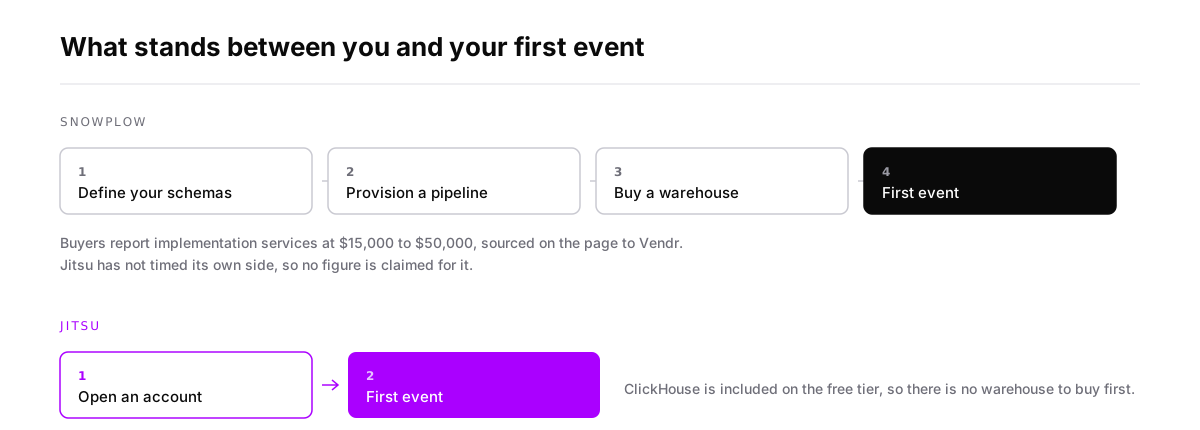
With Jitsu it is one thing: opening an account. There is no schema to author, no cloud account to provision and no warehouse to stand up.
The compounding part is what happens after. Snowplow delivers raw event data and most buyers then transform it into analytics-ready tables themselves. Jitsu lands structured data you can query immediately.
Asking somebody to buy a warehouse before they know whether the pipeline works is asking them to spend money to answer a question. That is a decision people postpone rather than make, and a postponed decision is indistinguishable from a no.
The trade runs the other way too. Teams arriving with a clear picture of what they want to measure get less out of Jitsu, because the step it removes is the one where you write it all down first. Snowplow is built for the team that has already had that meeting. Jitsu is built for the team that has not.
Side by side
| Jitsu | Snowplow | |
|---|---|---|
| Steps before your first event | Open an account | Provision a pipeline in your cloud, define your schemas, buy a warehouse |
| Implementation cost | None | Professional services commonly reported at $15,000 to $50,000 |
| Database included | Yes, ClickHouse on the free tier | No, warehouse bought separately |
| Free tier | 200,000 active events a month, permanent | 14-day free trial, then a quote |
| Published pricing | Yes | No |
| Start without a sales call | Yes | Yes, they offer a 14-day trial with no credit card |
| Infrastructure to provision first | None on the hosted tier | Pipeline runs in your cloud account |
| Schema required before sending | No | Yes, by design |
| Licence | MIT throughout, OSI-approved | Community Edition is under the Snowplow Limited Use License, source-available rather than OSI open source |
| Data ready to query on arrival | Yes | Raw events, modelled afterwards |
| Event validation | In a function you write | Built in, and central to the product |
| Bad events | Filtered by your function | Separated automatically |
What it costs
Snowplow publishes no pricing, so the honest comparison is between Jitsu's published rates and what their buyers report paying before the pipeline runs at all.
| Monthly volume | Jitsu | Snowplow |
|---|---|---|
| 200,000 active events | $0. Free tier, permanent, ClickHouse included | Free for 14 days, then implementation and a warehouse before the first billable event |
| 2 million events | $99, ClickHouse included | Quote, plus reported implementation, plus your own warehouse bill |
| 50 million events | $2,019, that is $99 for the first 2 million and $40 for each additional million | Quote, and the separate warehouse bill scales on its own |
Two things are easy to miss. The Jitsu free tier includes the database, so at 200,000 active events a month the total is zero rather than a free pipeline with a paid warehouse behind it. And captured events are unlimited — an event filtered out in a function never becomes an active event, so it is never billed.
Where Snowplow is genuinely ahead
Their data quality guarantee is real and Jitsu does not match it. Events are validated against a schema on arrival and failures are separated automatically. If you have inherited a warehouse full of events with inconsistent field names and mismatched types, that is the product built for you. Jitsu's answer is a validation function you write yourself, which gets you most of the way for none of the setup cost.
Their event model is richer. They have a well-developed approach to attaching context to events that Jitsu has no direct equivalent for.
They are the established choice for large data teams. If your organisation has already decided governance comes before speed, this page is solving a problem you do not have.
How you would move, or not move
If you are evaluating both. Open a free Jitsu account and send the same events to both. Jitsu costs nothing at evaluation volume and includes the database, so there is nothing to provision on that side and nothing to sign.
If you already run Snowplow and it works. This page is not asking you to replace it. The usual reason teams add Jitsu alongside is a second use case where the schema discipline is not worth the setup cost: a new product, a prototype, or a team that needs data this week.
If you are leaving. The work is repointing your SDKs and rebuilding your enrichments as Jitsu functions. Your existing schemas stay useful as documentation of what your events look like. Jitsu does not require them before you can send anything.
You can run Jitsu on your own servers on any tier, and the published pricing covers every self-serve volume. Other head-to-heads are on the comparison hub.
Questions people ask
What do I have to do before my first event? Open a Jitsu account. No schema, no cloud provisioning, no warehouse purchase. Snowplow asks you to define your schemas, provision a pipeline in your own cloud and buy a warehouse first, with professional services fees commonly reported on top.
Do I need a data warehouse first? Not with Jitsu. ClickHouse is included on the free tier. Snowplow requires you to buy one separately.
Can I try either one for free? Both. Jitsu's free tier is permanent at 200,000 active events a month. Snowplow runs a 14-day free trial with no credit card and no sales call, after which it is a quote.
Does Jitsu validate events? Not as a built-in product. You write validation into a function, which lives in your repository and is reviewed like any other code.
Is Snowplow open source? Their Community Edition is source-available under the Snowplow Limited Use License rather than an OSI-approved open source licence. Jitsu is MIT throughout.
Can an AI assistant set this up for me? Jitsu ships an MCP server, published on the official Model Context Protocol registry, so an assistant can create a destination, wire a connection and send a test event on your behalf. Snowplow has no server in that registry.
Get started with Jitsu
Open an account and send an event. There is no schema to author first, no cloud account to provision and no warehouse to buy — the free tier includes ClickHouse and covers 200,000 active events a month, permanently.