Jitsu vs PostHog
PostHog is a good product to send data to. It is not a good place to keep all of your data.
The moment events need to reach somewhere other than PostHog — a warehouse, an ad platform, an email tool — there is a routing problem PostHog was not built to solve. That is the job Jitsu does, and doing it in front of PostHog rather than behind it means one instrumentation, one place to filter, and one place to add the next destination.
Choose Jitsu if:
- Your events need to reach more than one destination, which is true of almost every company past its first year.
- You want the collection layer MIT licensed with nothing held back behind a paid tier. PostHog is open core.
- You want to self-host the pipe or run it in your own cloud account without losing functionality.
- You are at real volume, where being billed by an analytics vendor per event gets expensive.
- You want your analytics tool to be a choice you can change, rather than the thing your tracking is welded to.
Choose PostHog if: PostHog is the only place your events need to go, and what you want is analytics rather than infrastructure. Then Jitsu adds a hop and solves nothing, and you should install their SDK.
Use both, and most teams should: PostHog for product analytics, Jitsu for the pipe that feeds it alongside everything else. Nextlytics, built by Jitsu, ships PostHog as a supported backend, so this is a supported setup rather than a workaround.
What PostHog is
PostHog is an all-in-one product analytics platform. Web analytics, product analytics, session replay, A/B testing, feature flags, surveys and error tracking sit in one product, and it is open source with an analytics free tier covering a million events a month.
They have also added a customer data platform and a data warehouse, which is why they appear in this set at all. Historically they were a destination Jitsu would feed. That is still mostly true, and it becomes less true each year.
What Jitsu is
Jitsu is the collection and delivery layer, and it is the whole company rather than one module of something larger. Open source under MIT with nothing held back for paying customers, which is a meaningfully different promise from open core. It takes events from your site, app or servers, transforms them in JavaScript in flight, and delivers them to as many destinations as you need, PostHog included. It runs on Go, is backed by ClickHouse, and handles billions of events a month for customers today.
Jitsu does not do analytics. No funnels, no session replay, no experiments, and none are planned. That is the point: the pipe should not have opinions about which analytics tool you use, because you will change your mind about that and you should not have to re-instrument when you do.
A destination is not a pipe
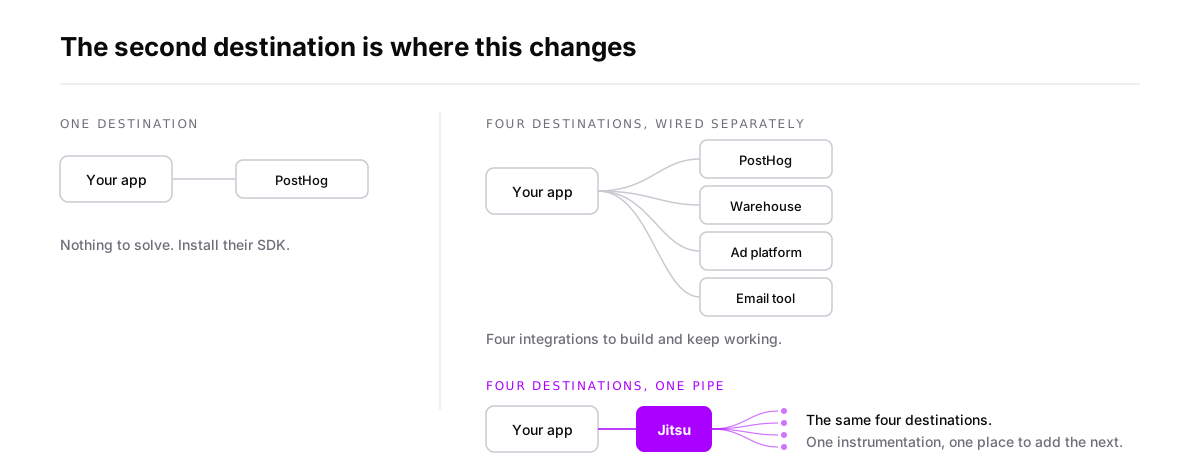
If every event you collect goes to PostHog and nowhere else, Jitsu adds a hop and solves nothing. Install their SDK and stop reading. That is honest, and it is also rare.
The moment there is a second destination the shape changes completely. Now somebody decides whether the warehouse is fed by PostHog's export or separately, whether the ad platform gets its own integration, what happens when the two disagree, and who owns the reconciliation. Every one of those decisions is a small permanent tax, and it compounds with each tool you add.
Almost nobody arrives at a pipeline because they wanted one. They arrive having outgrown not having one, and the pattern is consistent enough to describe before it happens to you. A team installs an analytics SDK. It works, and for a year there is no problem, which is why the top of this page says plainly that you should not move. Then finance wants the same events in the warehouse. Growth wants them in the ad platform. Somebody wires a second integration, then a third. Then two systems disagree about a number and an engineer spends a week working out which one is right.
That week is the real cost of the decision, and it lands long after the decision was made.
A collection layer in front of everything means one instrumentation, one place to transform and filter, and one place to add the next destination. It also means your analytics vendor becomes a choice rather than a foundation. If you decide in two years that you want a different tool, or your own warehouse models, or nothing at all, that is a configuration change rather than a re-instrumentation project.
Side by side
| Jitsu | PostHog | |
|---|---|---|
| Built to route to many destinations | Yes, that is the product | No, primarily itself |
| Licence | MIT throughout, nothing held back | Open core |
| Self-hosting | Yes, full product | Yes, with some features not included |
| Vendor stores your data | Optional | Yes, that is how the product works |
| Warehouse as a first-class destination | Yes, streaming | Via their warehouse product |
| Transform and filter in flight | Yes, JavaScript functions | Limited |
| Swap your analytics tool later | Configuration change | Re-instrumentation |
| Free tier | 200,000 active events a month | Analytics 1M events; data pipelines 10K events + 1M rows |
| Product analytics | None | Funnels, retention, cohorts, paths |
| Session replay, flags, experiments | None | Yes |
| MCP server for AI assistants | Yes, on the official registry | Yes, also on the registry |
What it costs
Both companies publish per-event pricing, and a table putting the two rates side by side would still mislead you, because the two columns do not buy the same thing. PostHog's price includes the analytics product. Jitsu's includes the pipe, a database, and delivery to as many destinations as you want. A cheaper rate on one side is not a cheaper stack.
What is cleanly comparable is where each one stops being free.
| Jitsu | PostHog | |
|---|---|---|
| Free tier | 200,000 active events a month, ClickHouse included | Analytics: 1M events. Data pipelines: 10K events + 1M rows |
| First paid tier | $99 for 2 million events | Per-product rate on a sliding scale, published on their pricing page |
Their free allowances are per product, and it is worth being precise about which one. The headline 1M is their analytics allowance, five times Jitsu's 200,000 and a real reason to start with them. Their data pipelines allowance — the product that does the job Jitsu does — is 10,000 events plus a million rows. Both numbers are on their page and both matter, depending on what you are actually buying.
Below a million events, if analytics is all you want, PostHog is free and Jitsu is not, and no argument on this page changes that. Above it, the question stops being the rate and becomes whether you want one bill for analytics or one bill for routing plus whatever analytics you choose.
For your own numbers: Jitsu is $99 for 2 million events and $40 for each additional million, so 5 million is $219 and 50 million is $2,019. PostHog's scale varies by product line and is on their page, which is why it is not reproduced here rather than approximated.
Where PostHog is genuinely ahead
Their analytics free tier is five times larger. A million events a month against Jitsu's 200,000. If you are small and staying small and analytics is what you want, that is a real reason to start with them.
They give you answers and Jitsu gives you data. A team of three who need to know which feature is being used will get further with PostHog in an afternoon than with any pipeline. Infrastructure only pays off once you have something to route.
Their developer reputation and documentation are excellent. Jitsu's are not there yet.
Their mobile SDK coverage is broader. If mobile is your primary surface, check Jitsu's SDK list against your platforms before deciding.
How you would move, or not move
If PostHog is your only destination. Do not move. Install their SDK. Jitsu would add a hop and solve nothing.
If you are adding a second destination. This is the moment to put a pipe in front rather than to wire a second integration. Send events to Jitsu, and PostHog becomes one destination among several rather than the place everything has to pass through.
If you already have both and they disagree. That is the reconciliation tax this page is about, and it is usually solved by making one system the source and the other a consumer of it. Jitsu is built to be the source.
Jitsu can run on your own servers on any tier, the pricing is published for every self-serve volume, and other head-to-heads are on the comparison hub.
Questions people ask
Is PostHog a competitor or a destination? Mostly a destination, increasingly also a competitor since they added a customer data platform.
Can Jitsu send events to PostHog? Yes, and the Nextlytics library lists PostHog as a supported backend.
Which free tier is more generous? For analytics, PostHog's, by five times — a million events a month against Jitsu's 200,000. For the pipeline itself their allowance is 10,000 events plus a million rows, so it depends which product you are comparing.
Do I need both? Only if you have destinations beyond PostHog. If you do not, you do not need Jitsu.
Is PostHog fully open source? It is open source and open core. Jitsu is MIT throughout, with no feature held back for paying customers.
Can an AI assistant operate either one? Both ship an MCP server and both are published on the official Model Context Protocol registry. That makes them the only two products in this comparison set where that is true, since RudderStack, Segment, Hightouch and Snowplow have no first-party server in that registry.
Get started with Jitsu
If PostHog is the only place your events need to go, install their SDK — this page is not for you. If you are adding a second destination, put the pipe in front first. Jitsu's free tier is 200,000 active events a month with ClickHouse included, and PostHog stays a supported destination.