Jitsu vs RudderStack: Licence and Price
Same architecture, same billing model, and Jitsu costs roughly five times less per event at the entry point, under a licence that does not restrict you. This is the closest comparison in the set, which is exactly why the two differences that remain decide it.
Choose Jitsu if:
- You might ever put an event pipeline inside your own product, or run one for clients. RudderStack's licence forbids that. MIT does not.
- Price per event matters. Their entry tier is $265 a month for 1 million events. Jitsu is $99 for 2 million.
- You want to deploy in your own cloud without being pushed onto an enterprise contract to do it.
- Your volume goes past 25 million events a month, which is where their self-serve pricing stops and a sales process starts.
- You would rather validate events in code you own than in a configuration screen you rent.
Choose RudderStack if: you need HIPAA, which they offer on Enterprise and Jitsu does not offer at all; or you need schema enforcement as a shipped product rather than as a documented function.
Per-event billing is not a differentiator here. Both companies do it, and claiming otherwise loses a reader who already knows their pricing.
What RudderStack is
RudderStack is a warehouse-first event pipeline. Their central pitch is that they do not store your data on their own infrastructure, which is a strong argument in regulated industries, and their own sales team leads with it into healthcare and financial services specifically.
They ship a governance toolkit covering a data catalog, tracking plans, schema enforcement and quarantining of invalid events. They support transformations in JavaScript and Python, and user profiles defined in YAML and computed inside your own warehouse.
What Jitsu is
Jitsu is an open-source event pipeline under the MIT licence. It collects events, transforms them in JavaScript in flight, and delivers them to your warehouse and your tools. It runs as a hosted service, as a dedicated deployment, or entirely on your own servers — on every tier rather than only at enterprise. The repository is at github.com/jitsucom/jitsu.
Jitsu is the smaller company. It is also the cheaper one by a wide margin and the more permissively licensed one.
Same billing model, different licence
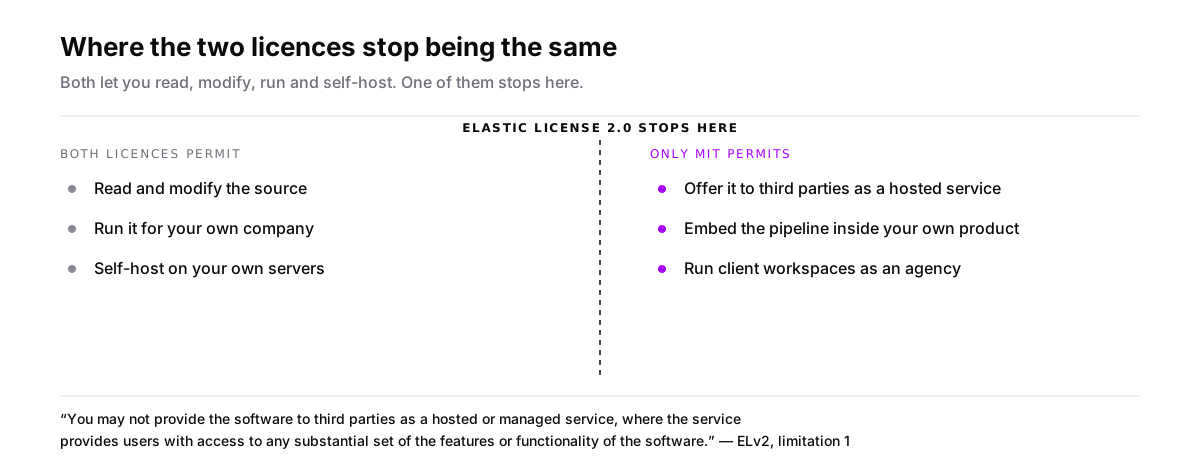
The licence half first, because it is the part people discover late. RudderStack's server is published under the Elastic License 2.0, which is source-available rather than an OSI-approved open source licence. It lets you read, modify and run the code. Its first limitation reads:
You may not provide the software to third parties as a hosted or managed service, where the service provides users with access to any substantial set of the features or functionality of the software.
Jitsu is MIT, which places no such restriction.
That difference is abstract until you are the one it applies to. If you are a software company that might one day embed an event pipeline inside your own product, or an agency running infrastructure on behalf of clients, it decides whether the free version is usable at all.
There is a legitimate answer on their side: buy RudderStack Cloud and run a paid instance per client. That works, and it is also the point at which this stops being a licence comparison and becomes a price comparison.
The price half is simpler. Their free tier is 250,000 events a month against Jitsu's 200,000, so they are more generous at the very bottom. Above that it inverts sharply: their cheapest paid plan is $265 a month for 1 million events while Jitsu is $99 a month for 2 million. That is roughly five times the cost per event at the entry point.
Side by side
| Jitsu | RudderStack | |
|---|---|---|
| Licence | MIT, OSI-approved, no restrictions | Elastic License 2.0, source-available rather than OSI open source, and it bars providing the software to third parties as a hosted or managed service |
| Billing basis | Per event | Per event |
| Free tier | 200,000 events a month | 250,000 events a month |
| Entry paid tier | $99 for 2 million events | $265 for 1 million events |
| Self-serve ceiling | Published through Enterprise | Stops at 25 million events |
| Self-hosting | Yes | Yes, within the licence terms |
| Deployment in your own cloud | Yes, on all tiers | Enterprise plan only |
| Data stored on the vendor's side | Optional, ClickHouse ships in the free tier | No, by design |
| Schema enforcement | In a function you write, see below | Yes, tracking plans with quarantine |
| Transformations | JavaScript functions | JavaScript and Python |
| Destination catalog | Smaller. Check your own list against it | Larger |
| HIPAA | Not offered | Enterprise plan only |
| MCP server for AI assistants | Yes, on the official registry | No server in that registry |
What it costs
Both companies publish per-event pricing, which makes this the one comparison in the set where the numbers sit side by side with nothing estimated.
| Monthly volume | Jitsu | RudderStack |
|---|---|---|
| 250,000 events | $99 | $0, the top of their free tier |
| 1 million events | Covered inside the $99 plan | $265 |
| 2 million events | $99 | No 2 million tier published. Their next one up is 3 million at $735 |
| 5 million events | $219, that is $99 plus $40 for each additional million | $995 |
| 10 million events | $419 | $1,675 |
| 25 million events | $1,019 | $2,750, their self-serve ceiling |
| Above 25 million | Published tiers continue | Contact sales |
Their free tier is the one row where they win outright, and at 250,000 events a month it wins by a quarter. Above it the gap is widest through the middle of the ladder and narrows at the top: $995 against $219 at 5 million, closing to $2,750 against $1,019 at their 25 million ceiling. Every figure in both columns comes from a published page.
Where RudderStack is genuinely ahead
They ship schema enforcement and Jitsu does not. Tracking plans, quarantine, the whole governance toolkit. If bad data reaching your warehouse is a problem you have already been burned by, take that seriously. Jitsu's answer is below and it is a real answer rather than a deflection, but it is a different shape and you should judge it on its merits.
They store nothing on their own infrastructure, and that is a genuinely strong position. Everything is processed and passed through to your warehouse. If your security review starts with where the data rests, that architecture answers the question before it is asked. Jitsu ships ClickHouse in the free tier, which most teams treat as a feature, but it does mean the honest answer to "do you hold our data" is "only if you choose to" rather than "never".
They offer HIPAA on Enterprise and Jitsu does not offer it at all. If you are handling protected health information, that ends the conversation and you should buy theirs.
Their destination catalog is larger. Check your actual list against Jitsu's before treating that as decisive, because most teams use a handful and the ones that matter are covered on both sides.
They support Python transformations as well as JavaScript. Jitsu's are JavaScript only. For most teams writing a filter or an enrichment, that is not the constraint.
Their free tier is larger. 250,000 events a month against 200,000.
Schema: a screen you configure, or code you own
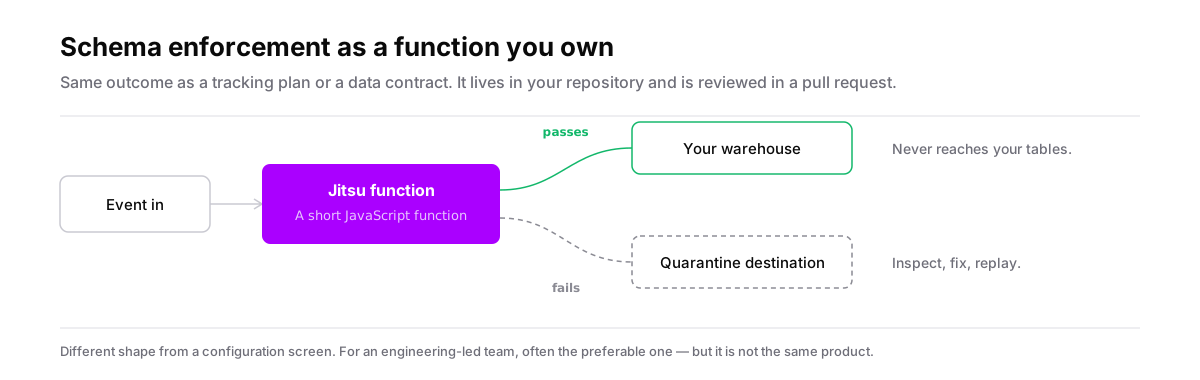
A Jitsu function is JavaScript that runs on every event as it passes through. A short one will check that an event carries the fields and types you expect and route the failures to a separate destination instead of your warehouse.
You get the same outcome their tracking plan gives you, with three differences: it lives in your repository, it is reviewed in a pull request like everything else you ship, and you can express rules a configuration screen cannot.
That is not better for every team. If you want governance you configure rather than write, they built that and Jitsu did not.
How you would move, or not move
If you are evaluating both. Both accept Segment-format events, so you can point a copy of your stream at each and compare the output and the bill on your own data before deciding anything.
If you already run RudderStack Cloud. The switch is a configuration change rather than a rewrite. Your existing tracking calls keep working, your destinations get recreated, and your transformations get rewritten as Jitsu functions, which is the only part that takes real time.
If you self-host RudderStack today. Read the first limitation in their licence against what you actually do with it. If you run it for anyone other than yourself, that is the conversation to have before anything else, and it is the reason most people arrive on this page.
Jitsu can run on your own servers on any tier and the pricing is published for every self-serve volume. Other head-to-heads are on the comparison hub.
Questions people ask
Is RudderStack open source? Their server is source-available under the Elastic License 2.0, which permits self-hosting but forbids offering it as a service to others. Jitsu is MIT licensed with no such restriction.
Do both bill per event? Yes. This is the one comparison where the billing model is not the difference.
Can I self-host either one? Both, though only one of the two licences lets you build a commercial service on top.
Does Jitsu have tracking plans? Not as a product feature. You can achieve the same validation in a function that lives in your repository and is reviewed in a pull request.
Which is cheaper? Jitsu, at every volume above the free tier. Their free tier is larger at 250,000 events a month against 200,000.
Can an AI assistant operate either pipeline? Jitsu ships an MCP server published on the official Model Context Protocol registry, so an assistant can create a destination, wire a connection and send a test event on your behalf. RudderStack has no server in that registry.
Get started with Jitsu
Both accept Segment-format events, so the cheapest way to settle this is to point a copy of your stream at each and read the two bills. Jitsu's free tier is 200,000 active events a month with ClickHouse included, and the licence question only matters if you already know the answer to it.