On-Premise CDP: 9 Questions to Settle Before You Buy
Nine questions that came up in on-premise evaluations this autumn, in the order buyers asked them, with what a good answer looks like and how Jitsu answers each.

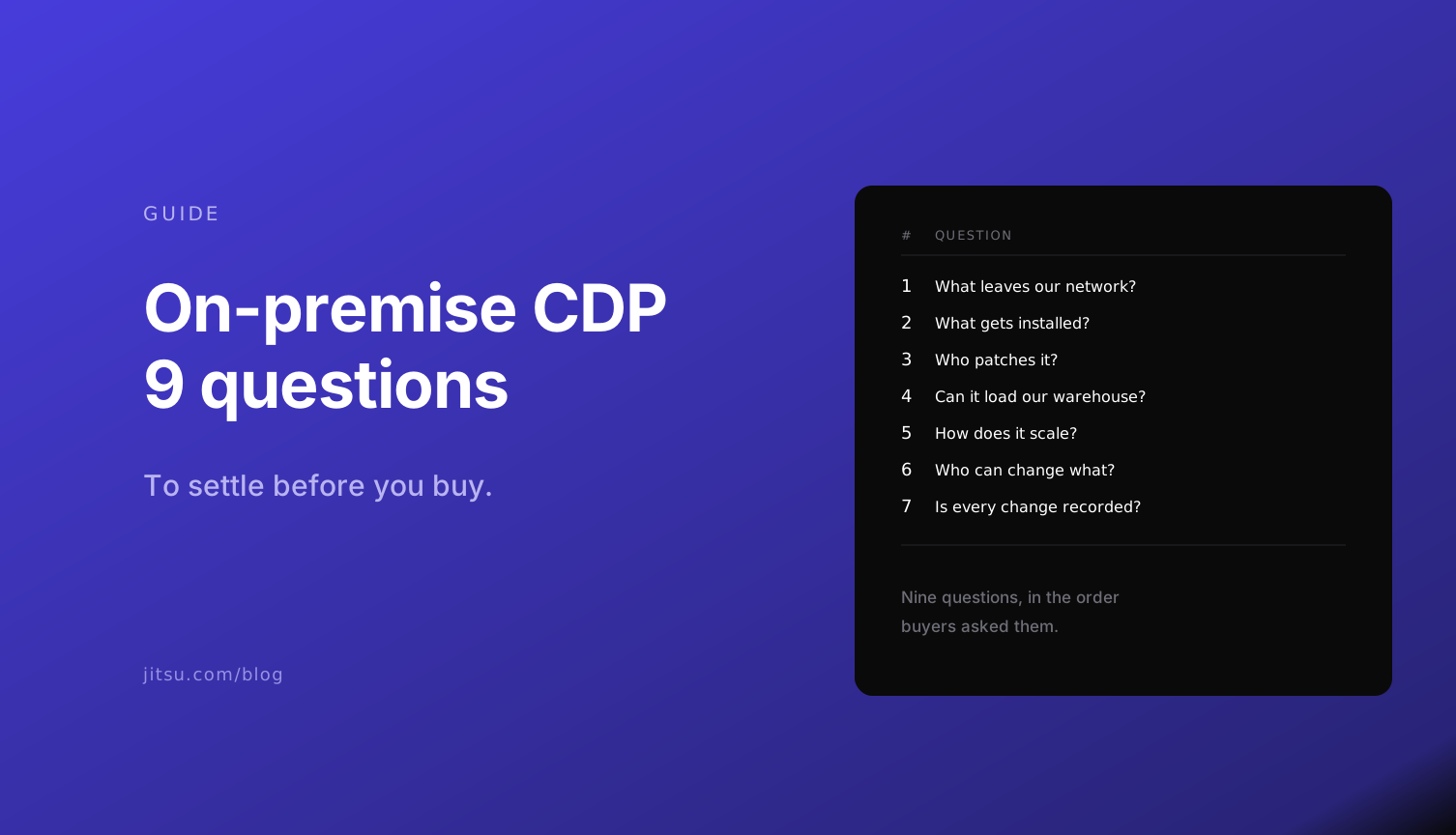
I have spent this autumn on calls and email threads with teams that cannot use a cloud CDP: a bank, a payments company, and consultancies buying for regulated clients. Different countries, different regulators, and almost the same list of questions every time.
One buyer put the starting point plainly: their regulations require the data to stay on their premises, so a cloud product was a no-go.
So here is the list, in the order people asked it, with what a good answer sounds like from any vendor and what Jitsu's answer is. If you are running this evaluation yourself, steal the questions.
1. What leaves our network?
This is the real question behind "do you support on-prem", and "nothing" is not an answer you should accept without a list. Ask for every outbound connection the software can make: where events go, whether the control plane is hosted by the vendor, whether there is a license server.
A self-hosted data plane with a vendor-hosted control plane fails this question for most regulated teams, because configuration and metadata still cross the boundary.
Jitsu's answer: the whole product runs inside your environment, console included. Events go only to the destinations you configure, and there is no license server.
2. What exactly gets installed?
You want the list of services and the list of things they depend on, because your platform team will be asked to run or approve each one.
Jitsu's answer is in the production deployment guide: it runs on Kubernetes as a handful of services (console, ingest, rotor, function servers, an operator, bulker) with PostgreSQL for configuration, Kafka for transport and ClickHouse for its own logs and metrics. MongoDB is needed for identity stitching and the function key-value store. The on-premise page has the full table.
3. Who deploys it, and who patches it?
"On-prem" covers two very different deals, and buyers mix them up. In one, the vendor's engineers deploy and maintain the install with access you grant. In the other, your team runs it and the vendor is support on the other end of a channel. Decide which one you are buying before you compare prices, and ask what the security patching process is in each.
With Jitsu, both are on the Enterprise plan, which comes with priority support and an uptime SLA: On Prem runs on your infrastructure, and Private Cloud is managed by Jitsu in a dedicated cloud account. Who does what on an On Prem install is scoped with your platform team before anything is deployed.
4. Can it load the warehouse we already run?
Nearly every team asking for on-prem already has a warehouse inside the boundary, and often a Kafka-to-warehouse job somebody maintains by hand. The CDP should load the warehouse you have, not bring its own and ask you to migrate.
Jitsu loads ClickHouse, Snowflake, BigQuery, Redshift, PostgreSQL and MySQL. Pointing it at an existing one takes a host and credentials, and Jitsu creates the tables and adds columns as new properties appear.
The pain this removes is specific. Without a pipeline, every new data request becomes a custom consumer and a scheduled production change. With one, a new event is a tracking call and a new rule is a function.
5. How does it scale, and what do we size for?
Ask which services scale by adding replicas and which need planning. Ask for a published reference at real volume. And size for where you will be in a few years, because on-prem hardware is bought ahead of need.
Jitsu's ingest, rotor and function servers scale by adding replicas, and the operator can autoscale the function servers. The published reference is Investing.com, one of the most visited financial sites in the world.
6. How do people sign in, and who can change what?
Your security team wants sign-in through the company identity provider and roles that separate people who can look from people who can change.
Jitsu has SSO via OIDC on the Enterprise plan and three workspace roles: owner, editor and a read-only analyst. Details are on the access control page.
7. Is there a record of every change?
A pipeline that holds warehouse credentials needs an audit trail, and with agents now editing configuration, the trail needs to say who or what made each change.
Jitsu's audit log records configuration changes with a field-level diff, membership changes and logins, and tags each with its origin: UI, API, CLI or MCP.
8. What happens if the contract ends?
Nobody asks this on the first call and everybody should. With a proprietary on-prem product, the end of the contract is the end of your right to run it. With a source-available license, read the restrictions before you build on it.
Jitsu is MIT licensed and the source is public. If the contract ends, the software keeps running and you keep the right to run and modify it. Your pipeline does not depend on a renewal.
9. What number goes in the budget?
Every buyer needs a figure before procurement will open a line, often months before go-live. Ask how the price is set, so you can estimate before the quote arrives.
On-prem Jitsu is on the Enterprise plan, which is priced per customer. The figure comes out of a scoping call, so have your current monthly event count ready for it.
Bring these nine questions to a call
<script
 async
 src="https://data.yourcompany.com/p.js">
</script>--get signup page views in the last day
select * from events where
context_page_path = '/signup' and
timestamp > now() - interval '1 day'