Segment pricing: how MTUs work and when they get expensive
Segment's pricing page publishes exactly two numbers, and neither is the one you will pay. Here is how the billing unit works and the one calculation that tells you whether you are on the wrong model.

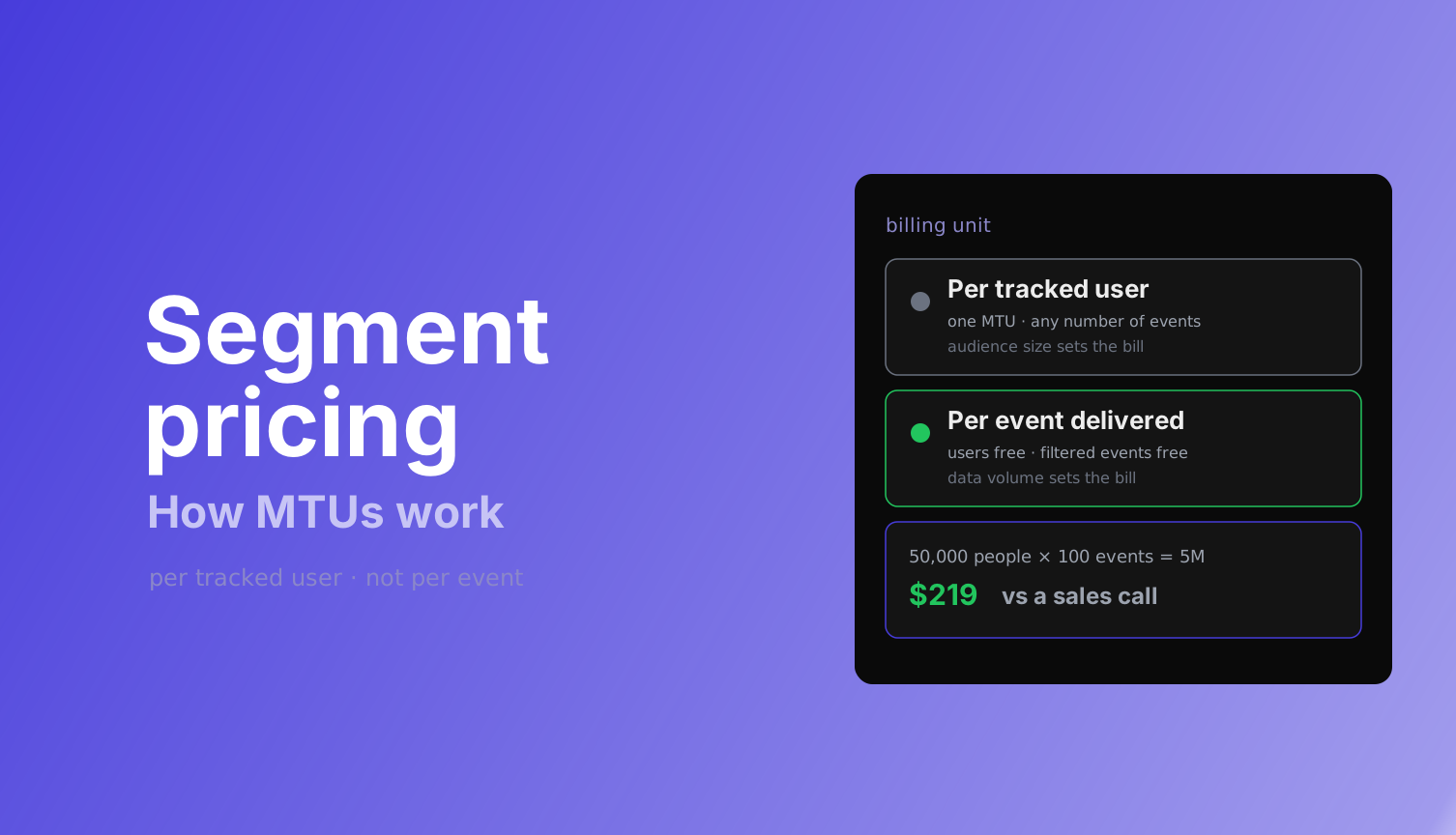
If you are trying to work out what Segment will cost you next year, the numbers are on their pricing page, but the one you will actually pay is not. Segment publishes a base price and three per-user overage rates. What it does not publish is the only figure that matters, which is how many users you are about to be billed for.
This post explains the billing unit Segment uses, what it costs at each published tier, and the three situations where the bill grows faster than the business does. We build an event pipeline ourselves and we bill on a different unit, so we have an interest here. Every number below links to where it came from.
Segment bills per user, not per event
Segment's billing unit is the monthly tracked user, usually shortened to MTU. An MTU is a unique user who generates at least one event in a calendar month.
Two things follow from that definition, and both matter more than they sound.
The first is that events inside an MTU are free. If one user fires five events this month or five thousand, you pay the same. Segment also deduplicates a user across web, mobile and server, so somebody who browses anonymously and then logs in counts once rather than twice.
The second is that the count resets every calendar month. A user who is active in January and again in June is billed as an MTU in both months.
What the tiers cost
The free tier covers 1,000 MTUs and two sources.
The Team plan is $120 a month for 10,000 MTUs with unlimited sources.
Above 10,000 MTUs the Team plan meters, and those rates are published too: $12 for each additional 1,000 MTUs between 10,000 and 25,000, $11 per 1,000 from 25,000 to 100,000, and $10 per 1,000 above that.
The Business tier is where the published numbers stop. Segment lists it as a custom quote, and Vendr, which tracks what companies actually pay for software, describes it the same way: priced on MTU volume and feature requirements.
So the arithmetic is available to you well past the entry plan. Most people never do it, because the input is a number they do not have.
Where MTU pricing gets expensive
Your marketing site counts. An MTU is a unique user who fires an event, and an anonymous visitor reading a blog post fires events. A company with 200,000 monthly readers and 2,000 customers is billed on the readers.
Growth in users costs more than growth in usage. If your product becomes more valuable to each existing customer, you send more events per user and the bill does not move. If you acquire more users, the bill moves in step with them. That is the wrong way round for most consumer products, where user growth is the thing you are trying to cause.
The 10,000 MTU ceiling arrives early. Ten thousand monthly active users is a small consumer product. Crossing it does not put you straight into a sales call, but it does start the meter: every further 1,000 users adds $12, then $11, then $10, on top of the $120 base. Growing from 10,000 to 50,000 users takes the bill from $120 to $575 with nothing else about the product changing.
What per-event pricing does instead
We bill on events delivered to a destination. Captured events are free and unlimited on every plan, so if you filter an event out in a function before it reaches your warehouse, you are not billed for it.
Take a consumer app with 50,000 monthly active users each generating 100 events, which is 5 million events a month.
On our pricing that is $99 for the first 2 million plus $120 for the remaining 3 million. $219 a month, and you can check that arithmetic yourself before talking to anybody.
On Segment that is 50,000 MTUs. Working down their published rates, it is $120 for the first 10,000, $12 per 1,000 for the next 15,000, and $11 per 1,000 for the last 25,000. That comes to $575 a month.
So the same traffic is $219 on our pricing and $575 on theirs, and you can check both figures before you talk to anybody.
When Segment is the cheaper choice
MTU pricing is genuinely better when you have a small number of users each generating a large number of events.
Take a B2B product with 500 seats where every seat fires 10,000 events a month. That is also 5 million events. On Segment it is 500 MTUs, which fits inside the free tier. On our pricing it is $219 a month. Segment wins outright and it is not close.
The general rule is that MTU pricing rewards depth of instrumentation and punishes breadth of audience, and per-event pricing does the opposite. If your product is heavily instrumented for a small set of users, Segment's model is on your side and you should keep it.
How to work out which side you are on
Divide your monthly events by your monthly active users.
If that number runs into the thousands, MTU pricing is working in your favor.
If it sits in the tens or the low hundreds, you are paying for the size of your audience rather than for the data you collect, and per-event pricing will be cheaper.
That holds once you are paying for something. Segment is free up to 1,000 tracked users and we are free up to 200,000 delivered events a month, so below both of those lines the ratio is choosing between two bills of nothing. Between them it can point the wrong way: 900 users sending 300 events each is 270,000 events a month, which is inside Segment's free tier and outside ours.
Between 10,000 and 100,000 tracked users you do not have to rely on the rule at all. Segment publishes a rate for every band in that range and we publish ours, so both bills are arithmetic rather than estimates.
If you do not know your event count, that is worth finding out before your next renewal whichever vendor you end up with.
If you want to test the other model
Our JavaScript integration is API-compatible with Segment's, so you can point existing tracking calls at us without rewriting your instrumentation. You can also run both at once by adding a webhook destination inside Segment that sends a copy of every event to us, which lets you compare the two bills on your own data before deciding anything.
The full head-to-head, with both pricing pages worked at three volumes and the cases where Segment is the better choice, is at Jitsu vs Segment.
And if you are comparing more than the two of us, we published an honest ranking of open-source and self-hosted CDPs earlier this year. We do not rank ourselves first in it.
Compare your event bill on your own data
<script
 async
 src="https://data.yourcompany.com/p.js">
</script>--get signup page views in the last day
select * from events where
context_page_path = '/signup' and
timestamp > now() - interval '1 day'